

Publications Ethics

The Journal of Sinergi Komunitas Pengabdian (SIKOP) is committed to upholding the ethics of scientific publication in the publication of community service articles. To ensure manuscript quality and prevent publication violations or plagiarism, the entire publication process involves authors, editors, and reviewers; these publication ethics guidelines must uphold the principles of honesty, professionalism, objectivity, and academic responsibility.

Section A: Publication and Authorship

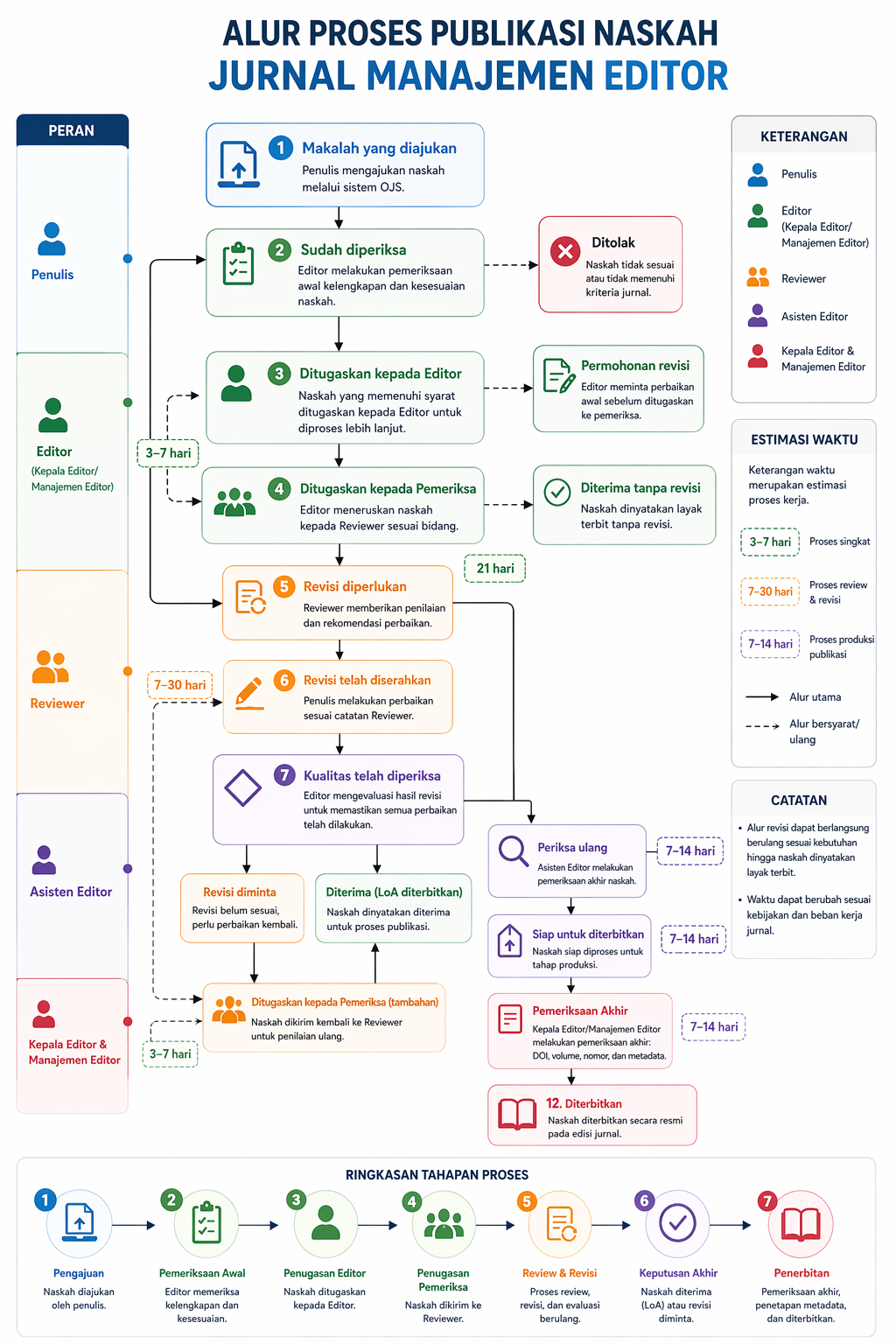
  1. All submitted articles will undergo a peer-review process by at least two reviewers who are experts in the relevant field of community service.
  2. The article review process uses the single-blind peer-review method.
  3. Articles are evaluated based on their suitability, including relevance to the journal scope, originality, contribution to society, quality of writing, and language use.
  4. The final decision on an article may be acceptance, acceptance with revisions, or rejection.
  5. Articles revised by the author will be reviewed again by the editor or reviewers. However, resubmission of a revised manuscript does not guarantee acceptance for publication.
  6. Rejected articles will not be processed or reviewed again.
  7. Article submissions must comply with ethical guidelines for scientific publication, including those regarding copyright, originality, and plagiarism.
  8. Submitted articles must not have been previously published or be under consideration by another publication.

Section B: Authors’ Responsibilities

  1. Authors must ensure that the manuscripts submitted are original works of community service, have not been previously published, and are not under consideration by other journals.
  2. Authors must present the processes and outcomes of community service activities honestly, accurately, and objectively, in accordance with established norms, ethical standards, and community needs.
  3. Authors must participate in the peer-review process.
  4. All listed authors must have made significant contributions to the activities, research, and writing of the article.
  5. All data, results, and documentation related to community service activities must be accurate, valid, and verifiable.
  6. Any conflicts of interest must be disclosed.
  7. Authors must be willing to make revisions based on suggestions from editors and reviewers.
  8. Authors must use reference sources properly and responsibly.
  9. Authors are fully responsible for the entire content of the published article. Any errors discovered after publication must be reported to the editor immediately.

Section C: Reviewers’ Responsibilities

  1. Reviewers assist editors in evaluating the quality, usefulness, and contribution of the community service activities reported in the articles.
  2. Reviewers must maintain the confidentiality of all information related to the manuscripts they review.
  3. Reviewers must provide objective, constructive, and timely feedback.
  4. Reviewers should provide recommendations to improve the quality of community service articles. Reviews must remain objective and free from personal criticism.
  5. All opinions and evaluations must be supported by clear arguments.
  6. Reviewers must notify the editor if there are indications of plagiarism or violations of publication ethics.
  7. Reviewers must avoid any conflicts of interest related to the manuscripts they review.

Section D: Editors’ Responsibilities

  1. The editor is responsible for determining the suitability of articles based on manuscript quality and alignment with the focus and scope of the community service journal.
  2. The editor has full authority to accept or reject articles.
  3. The editor is responsible for maintaining publication quality and must act objectively, professionally, and without discrimination.
  4. Editors must maintain the confidentiality of manuscripts and authors’ identities.
  5. Editors must ensure that the review process is conducted fairly, transparently, and in a timely manner.
  6. The source of funding must be clearly identified and understood.
  7. Publication decisions must be based on review results, as well as the quality and relevance of the community service articles. Decisions should not be reversed without strong justification.
  8. Editors must follow ethical guidelines in all editorial processes.
  9. Articles should only be accepted when there is reasonable certainty regarding their quality and integrity.
  10. Editors must take appropriate action against any alleged ethical violations.
  11. Rejection of an article must be based on evidence and objective evaluation, not mere suspicion.
  12. Editors must avoid conflicts of interest throughout the editorial process.